
You’ve seen it happen. A brilliant client, a surgeon, an engineer, a business owner who reads everything, calls you in a panic during a market drop and demands you sell everything before it gets worse. You walk them through the history, the recoveries, the math that says holding is the right move, and they nod, and then they say it again. Sell. These are not foolish people. They are some of the smartest people you know, and in this moment their intelligence has gone completely offline. Understanding why is one of the most valuable things an advisor can learn, because the clients who feel that pull are the ones who most need you to hold the line.
Part of my own training took me through Harvard’s executive program on Investment Decisions and Behavioral Finance, and the lesson that stayed with me longest is this. Your clients’ worst financial decisions are rarely failures of knowledge. They’re failures of biology, a brain doing exactly what evolution built it to do, and you cannot fix a biological response with a spreadsheet. Once you understand what’s happening inside a frightened client, you stop arguing with them and start helping them, and that shift transforms your value.
The Hijack That Shuts Down a Smart Brain
Deep in the brain sits the amygdala, a small, almond-shaped structure that works as your threat detector. It evolved to keep our ancestors alive when something with teeth came out of the grass, and it’s fast, powerful, and completely unable to tell the difference between a predator and a plunging portfolio. When it senses danger, whether that’s a market crash, a job loss, or a surprise expense, it floods the body with cortisol and adrenaline and redirects blood flow away from the prefrontal cortex, the part of the brain where calm, rational thinking lives. Scientists call this an amygdala hijack, and it’s the reason genuinely smart people make genuinely terrible money decisions under stress.
Think about what that means in your conference room. During a bear market, your client’s threat detector reads those portfolio losses as a lion in the grass, and the rational knowledge that markets always recover is not weakened, it’s literally offline, starved of blood flow. The only thing that feels right is to stop the pain immediately by selling now. Your client isn’t being stupid. Their prefrontal cortex has been benched, and you are trying to have a reasonable conversation with a brain that has temporarily lost access to reason. No amount of data reaches a person in that state, because data is processed in the very region that just went dark.
You cannot fix a biological response with a spreadsheet.
This is why the instinct most advisors reach for, more information, almost always fails. We see a frightened client and we pile on charts, historical returns, and probability tables, certain that if they just understood the facts they’d calm down. But information was never the problem. The client who wants to panic-sell already knows markets recover, they could look it up in thirty seconds, and it doesn’t help, because facts do not calm an amygdala in full hijack. Information doesn’t sit with someone in their fear. It doesn’t make them feel less alone. Pour more data on a panicking client and you’re reading a fire-safety pamphlet to someone whose kitchen is already in flames.
What This Costs, in Hard Numbers
If you think this is a soft, touchy-feely concern, the data says otherwise, and it’s staggering. DALBAR’s long-running Quantitative Analysis of Investor Behavior tracks the gap between what the market returns and what the average investor actually earns, and that gap has a single dominant cause: emotional decisions made at the worst possible moments. In 2024, the S&P 500 returned about 25 percent, while the average equity fund investor captured only about 16.5 percent, underperforming the index by roughly 848 basis points. That gap didn’t come from bad funds or bad markets. It came from human beings selling in fear, chasing rallies, and abandoning the plan precisely when they should have held.
Read that again through the lens of your own value. The single biggest threat to your clients’ wealth isn’t the market, it’s their own behavior in the moments the market frightens them. And behavior in those moments is exactly what a present, steady advisor exists to manage. The advisor who can keep a client in their seat through a downturn delivers more measurable value than any clever allocation, because they’re closing the gap that quietly drains real portfolios every cycle. This is the most important work you do, and it has nothing to do with picking investments.
What Actually Works: Name It, Slow It, Anchor It
So if facts don’t reach a hijacked brain, what does? The answer is a sequence that addresses the emotion first and the decision second, and it begins with naming what the client is feeling. Before you touch the decision itself, say something that shows you see the fear, like “I can hear how stressful this market is for you,” or “I certainly understand and appreciate how you feel,” or “I understand the fear behind wanting to sell.” This isn’t a throwaway pleasantry. Naming an emotion out loud measurably lowers its intensity and begins to bring the prefrontal cortex back online. You are not agreeing they should sell. You are showing them they’re not alone in the fear, and that alone starts to settle the storm.
One caution, though, and it matters more than any script. A client can tell in an instant whether you mean it. “I understand how you feel” delivered as a reflex, a box to check before you pivot to your charts, lands as hollow and can do more harm than saying nothing. The same words spoken by an advisor who has slowed down, looked the client in the eye, and genuinely put themselves in that client’s shoes create real connection. Empathy is not a phrase you deploy. It’s a posture you adopt. Feel it first, then say it, because the client is reading your sincerity far more than your vocabulary.
Once the emotion has been named, gently explain what’s happening inside them, because understanding it creates a sliver of distance between the feeling and the action. You might say, “Right now your brain is in threat mode. It wants to stop the pain immediately, which is exactly what brains are built to do when they sense danger. The fear is real and valid, and it’s a separate question from what we should actually do.” Then slow the decision down, because the hijacked brain craves instant resolution and your job is to buy time for reason to return. “This doesn’t have to be decided today. Let’s sit with it for forty-eight hours and talk again.” The pause itself is the medicine.
Finally, anchor them back to their own values, the words they gave you when they were calm. “Six months ago you told me that retiring with confidence was what mattered most. Does selling everything today move you toward that or away from it?” This is where listening pays its richest dividend, because you can only anchor a client to values you bothered to learn in the first place. The advisor who knows what this specific client is truly afraid of, and what they truly want, can guide them home in a way no script and no software ever could.
The Bias Behind the Behavior
It helps to recognize the specific patterns, because each one has its own tell and its own response. Loss aversion makes losses feel about twice as painful as equivalent gains feel good, which is why a client will refuse to sell a stock down 40 percent, insisting they’ll wait until it returns to break even, even as the concentrated position quietly grows riskier. The cure isn’t a lecture, it’s a reframe in the form of a question: “The original decision is done and we can’t change it. The real question is whether you’d buy this stock today with cash sitting in your account. Would you?” Almost always the answer is no, and now they can see they’re actively choosing to hold something they wouldn’t buy.
Recency bias convinces clients that whatever just happened will continue forever, so they want to pile into whatever soared last year. When a client is certain tech is the only place to be because it’s climbed for three straight years, you don’t counter with history they’ll wave off. You ask, “What makes you confident it keeps climbing now that everyone else can see the same thing you do?” The question lets them discover, on their own, that the obvious trade is already priced in. Across every bias, the move is the same. Don’t argue, don’t accuse, and don’t bury them in data. Ask a question that lets the client’s own reasoning come back online.
Your One Takeaway This Week: Name the Emotion First
The next time a client comes to you frightened or fixed on a decision you know is driven by fear, resist every instinct to open with facts. Before you offer a single number, name what they’re feeling out loud: “I can hear how much this is weighing on you.” Watch their shoulders. Naming the emotion lowers its grip and brings their thinking brain back to the table, and only then are they able to hear anything you have to say. You’ll find the conversation you have after those words is a completely different one than the conversation you used to have.
The One Thing AI Will Never Do Here
This is where the human advisor becomes irreplaceable, no matter how sophisticated the technology gets. AI is already good at spotting emotional states and biases. It can flag recency bias, detect anxiety in a client’s language, and serve up a perfectly worded behavioral nudge. But everything AI offers in that moment is still information, and you already know information doesn’t calm a hijacked brain. A chatbot can tell a panicking client that markets recover. So can a Google search. Neither one sits with the client in their fear, and neither one makes them feel less alone at two in the morning when the headlines are screaming.
There’s a line I learned long ago that captures it. Emotions are caught, not taught. When I look a frightened client in the eye and say, “I’ve seen this before, and I know we’ll get through it,” I’m not delivering a fact, I’m transferring conviction, and my steadiness becomes theirs. AI can produce the identical words, but the conviction isn’t in the words, it’s in the human who has lived through it and means it. In a world where information is free and endless, the calm of a trusted human is the rarest and most valuable thing you bring to the table.
The Bottom Line
Your clients don’t need you to be a better calculator, because the calculators already won that contest. They need you to be the steady presence who understands that their worst decisions come from a frightened brain doing what frightened brains do, and who knows how to bring them back to clarity. Name the fear, slow the moment down, and anchor them to what they told you they wanted when they were calm. Do that, and you don’t just protect their portfolio. You become the person they call first in every storm for the rest of their lives.
That is the advisor clients refer, advocate for, and never leave, the one who guides them through the moments no spreadsheet ever could.
Ready to become the advisor no machine can replace?
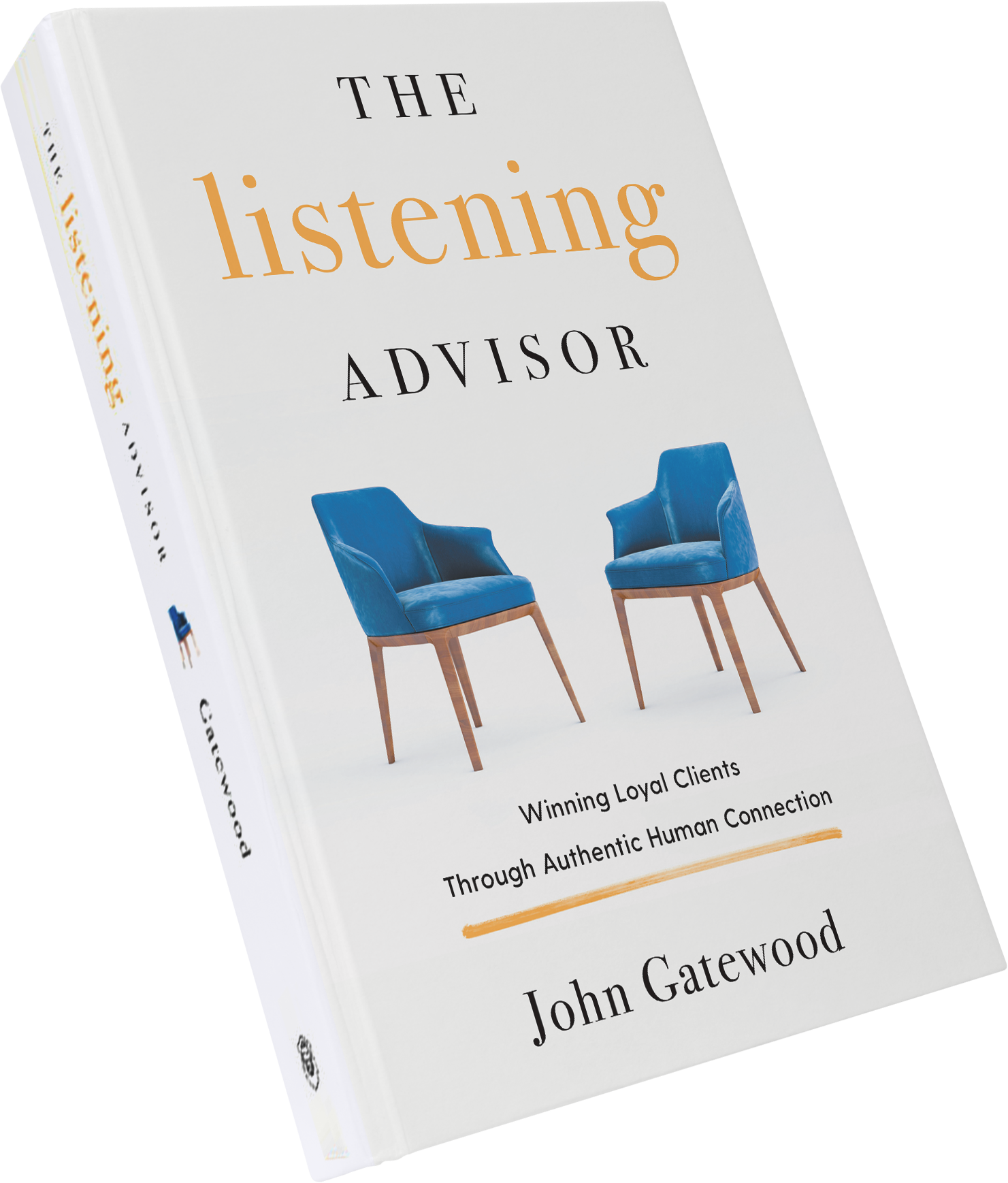
Pick up a copy of The Listening Advisor, or reach out to learn how The Listening Advisor™ can help you grow your AUM, deepen client relationships, and win clients who refer, advocate, and never leave.
John Gatewood is a CERTIFIED FINANCIAL PLANNER™ professional with forty-five years in financial services, a graduate of Harvard’s executive program on Investment Decisions and Behavioral Finance, and the author of The Listening Advisor: Winning Loyal Clients Through Authentic Human Connection.