
Picture the most technically brilliant advisor you know. They can model a Roth conversion in their head, quote the tax code from memory, and explain a sophisticated estate structure without notes. They walk into every client meeting as the smartest person in the room, and they make sure everyone knows it. Now ask yourself a harder question. Do their clients love them, or do their clients merely respect them? Because those are not the same thing, and the gap between them explains something you have watched happen in this business. The brilliant advisor in the room often plateaus, while a less experienced, less credentialed advisor down the hall keeps climbing, gathering loyal clients and growing assets at a pace the brilliant one cannot understand. The difference is rarely knowledge. It is usually connection.
I spent more than four decades in this business, including years as a top-ten advisor at my firm and the experience of building a practice from nothing before selling it in 2021. I can tell you that the moments that won me lifelong clients were almost never the moments I proved how much I knew. Expertise got me in the door. Something else kept people in their seats for twenty years. The advisors who lean entirely on being the smartest in the room are competing on the one thing that has quietly become a commodity, while neglecting the one thing that never will.
Expertise Is No Longer Rare
The last few years have made something undeniable that many advisors would rather not face. Technical knowledge, the thing we spent our careers accumulating, is no longer scarce. A client with a phone can pull up a Roth conversion explainer, a tax-bracket calculator, and a passable estate-planning overview in about ninety seconds, and now they can ask an AI assistant to walk them through the nuances in plain language. The sophisticated answer you were so proud of delivering is available to anyone, anywhere, instantly and for free. When the thing you sell becomes free everywhere else, leading with it is a losing strategy.
This is why being the smartest advisor in the room is a weaker position than it used to be. You are competing on a dimension where the machines have already caught up and the internet gave your answers away. Meanwhile, the data shows clients were never primarily buying your knowledge in the first place. In a Capintel survey of 1,000 investors, 72 percent said the top quality they look for in an advisor is simply “someone I can trust,” which ranked far above the advisor’s investing experience at 50 percent. And 61 percent said that losing trust would be the top reason they’d leave. Clients are not shopping for the smartest advisor. They are shopping for the one they believe truly understands them.
When the thing you sell becomes free everywhere else, leading with it is a losing strategy.
The Estate Attorney Who Knew Everything and Connected With No One
Let me show you how this plays out, because we have all watched it happen. Imagine sitting in a meeting with a brilliant estate attorney and your shared client. The attorney gathers just enough information to propose an intricate, technically flawless plan, then launches into it using terms like grantor retained annuity trust and generation-skipping transfer tax, nodding at his own sophistication. A week later he sends a ten-page letter detailing the structure and everything it will accomplish. Every word is correct. And the client sets the letter down, quietly overwhelmed, having understood almost none of it and, worse, having never once heard the attorney connect any of it back to what they actually said they wanted, which was simply to keep their kids from fighting after they’re gone.
Now picture the same meeting with an advisor who listens first. She asks what the client is really hoping to protect, hears the fear about the children, and then explains the very same structure in plain English. “This setup does one main thing for you. It makes sure the house passes to your daughter without your son being able to contest it, so the two of them never end up in a courtroom across from each other.” Same plan, same expertise underneath, completely different experience for the client. The attorney was the smartest person in the room. The advisor was the one the client will call first for the rest of their life. Knowledge built the plan. Connection delivered it.
Think about the last time you sat in a doctor’s office hearing something frightening. A physician who responds to your diagnosis by reciting treatment protocols, survival statistics, and pharmacology while never once pausing to ask what you’re afraid of leaves you more anxious than when you walked in, no matter how accomplished they are. The doctor who sits down, looks at you, and asks what worries you most before explaining anything earns your trust for life. The difference was never competence. Both doctors knew the medicine. The difference was whether you felt like a problem being solved or a person being seen.
Great Answers Demonstrate Knowledge. Great Questions Demonstrate Wisdom.
If expertise is the commodity and connection is the prize, the practical question becomes how you actually deliver connection inside a meeting. It turns out the answer is not something you say. It’s something you ask. The shift from giving answers to asking questions is how an advisor trades commoditized expertise for the one thing that can’t be copied, because a great question is the moment connection happens.
This is where the reframe earns its keep. Think about the difference between hearing “that’s a great answer” and hearing “that’s a great question.” A great answer informs the client and is often forgotten by lunch. A great question does something far more powerful. It makes the client think about their own situation in a way they never had before, and the instant that happens, they see the advisor differently. The question reveals an angle they hadn’t considered or an assumption they didn’t know they were making, and that fresh thinking signals wisdom, not just knowledge. It lifts the advisor onto higher ground, because anyone can supply facts, but the person who can make you see your own life more clearly is rare. That is the moment connection forms, and it is also the moment the client genuinely wants to hear what the advisor thinks. The question earns the answer.
That asymmetry is the whole secret. Great answers demonstrate knowledge, but great questions demonstrate wisdom, and in a profession where countless advisors can recite the same technical facts, wisdom is a durable advantage that holds its value.
When a typical advisor meets a client preparing for retirement, they ask the routine questions, like what age, what number, what risk tolerance. The listening advisor asks something the client has never been asked, such as “When you picture retirement, what are you retiring to, not just from?” and watches the client pause and say, “That’s a great question. I’ve been thinking about this as ending something, not beginning something.” In that small moment the relationship changes character. The advisor stops being a source of information, which is easily replaced, and becomes a thinking partner, which is irreplaceable. You cannot be commoditized once a client sees you as the person who helps them think more clearly about their own life.
Why We Default to Proving Instead of Understanding
If asking great questions is so powerful, why do so few advisors do it? The honest answer is that our entire training conditioned us backwards. From school through every professional designation, we were rewarded for having the right answers, and we learned that asking questions is what you do when you don’t know something. So we walk into meetings wired to perform our expertise, because delivering a sophisticated explanation makes us feel competent and justifies our fee, while sitting quietly and asking a question can feel like we’re not earning our keep. That instinct is powerful, and it is almost entirely wrong.
There’s a deeper fear underneath it, too. When you ask a great question, the client often goes silent because they need time to think about something they’ve never considered, and that silence makes many advisors deeply uncomfortable, so they rush to fill it by rephrasing or answering their own question, which destroys the very magic they created. The discomfort is the work. Being interested rather than interesting is one of the hardest skills in this profession, not because it’s technically complex, but because it requires overriding years of conditioning that told you success means showing how smart you are. Clients don’t hire you because you’re impressive. They hire you because they feel understood.
Your One Takeaway This Week: Trade One Answer for One Question
In your next client meeting, pick one moment where you would normally deliver an impressive explanation, and instead lead with a question that makes the client think. Replace “Here’s what I’d recommend” with “Before I share my thinking, help me understand what matters most to you here.” Then sit in the silence that follows without rescuing it. When the client says “that’s a great question,” you’ll know you just shifted from being a source of answers to being a partner in their thinking, and that is the position no competitor and no machine can take from you.
The Bottom Line
None of this means your expertise stops mattering. It matters enormously, and you should keep sharpening it, because the plan still has to be right. But expertise is the price of admission now, not the prize. The prize goes to the advisor who leads with understanding before advising, connection before content, and their story before your solution, the one who uses deep knowledge quietly in service of a human being rather than waving it like a trophy. Be brilliant, by all means. Just don’t let being the smartest person in the room cost you the trust that actually keeps clients.
Lead with wisdom instead of knowledge, and you become the advisor clients refer, advocate for, and never leave, no matter how smart the competition or how capable the technology.
Ready to become the advisor no machine can replace?
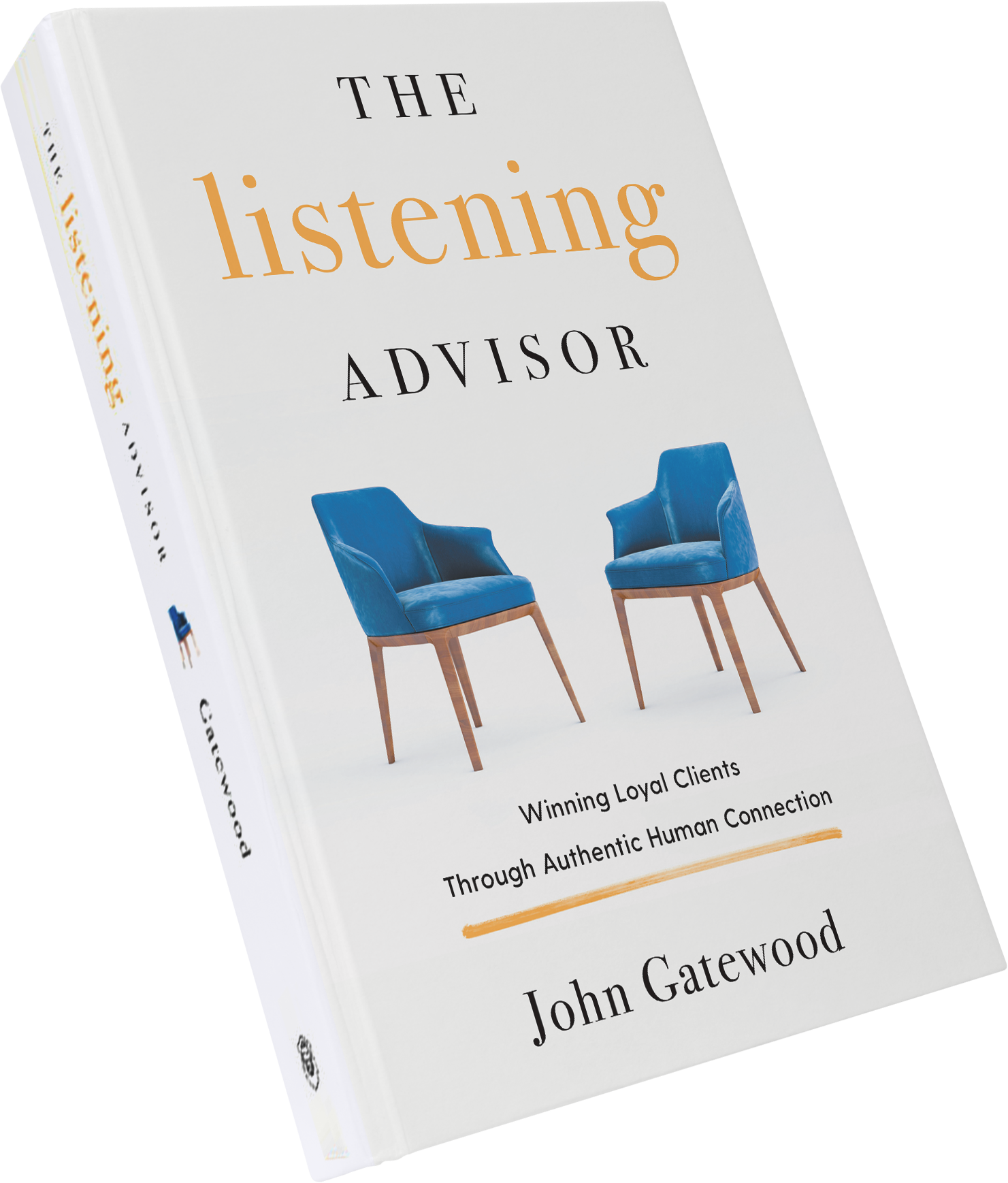
Pick up a copy of The Listening Advisor, or reach out to learn how The Listening Advisor™ can help you grow your AUM, deepen client relationships, and win clients who refer, advocate, and never leave.
John Gatewood is a CERTIFIED FINANCIAL PLANNER™ professional with forty-five years in financial services and the author of The Listening Advisor: Winning Loyal Clients Through Authentic Human Connection.