
So you walk them through the cash flow, the withdrawal rate, the probability of success, and they nod along, thank you, and leave. Two weeks later they still haven’t signed the paperwork, and you can’t figure out why, because you answered the question. The trouble is, you answered the question they asked, not the one they meant.
In a career that’s spanned more than four decades, including years as a Barron’s Top 1,200 advisor and a Forum-level representative at Northwestern Mutual, I’ve learned that a costly mistake an advisor can make isn’t getting the math wrong. It’s answering the wrong question perfectly. The client who asked whether they could retire at sixty-two might be asking something else entirely, like whether they’ll become a burden to their kids, or whether the career that defined them is really over, or whether they and their spouse even want the same retirement. Learn to hear that second question, the one underneath, and you’ll separate yourself from every advisor who only hears the first.
People Decide Emotionally and Justify Logically
Behavioral finance has confirmed something over and over, and it’s worth keeping in front of you in every meeting: people don’t make financial decisions rationally. They decide with emotion, instinct, and mental shortcuts, and then they reach for the charts and the logic afterward to justify what they’ve already felt. Most advisors do the reverse. We lead with the data, the efficiency, the meticulous plan, while the client across from us is running on fear, regret, hope, and the need to feel understood. I spent part of my own training studying this directly, through Harvard’s executive program on Investment Decisions and Behavioral Finance, and the lesson that stuck with me most is this: people choose their advisor emotionally and justify the choice logically. The question they say out loud is usually the logical wrapper around an emotional core they haven’t put into words yet.
The evidence shows up in how clients describe the advisors they love. In Wealthtender’s 2025 Voice of the Client Study, which analyzed more than 2,500 client reviews, only about one in ten even mentioned investment management or portfolio strategy. The overwhelming majority praised long-term planning, communication, and the human relationship that gave them peace of mind. Consider what that’s telling us. The thing we spend most of our energy perfecting, the portfolio, is the thing clients mention least when they explain why they stay. What they remember is whether you understood them, and understanding starts with hearing the real question.
A costly mistake an advisor can make isn’t getting the math wrong. It’s answering the wrong question perfectly.
The Iceberg in Every Meeting
Think of a client’s spoken question as the tip of an iceberg. What pokes above the waterline is small, hard-edged, and easy to point at, like a number, a date, a yes-or-no. But most of the mass sits below the surface where you can’t see it, and that submerged part is where the decision actually lives. When a client asks “Is now a good time to invest?” the question above the water is about timing. The mass below might be “I got burned in 2008 and I’m terrified of feeling that stupid again.” Answer the timing question with a market-timing discussion and you sail right past the fear that’s driving the whole conversation.
I watched this play out with a client years ago, a business owner I was helping with retirement planning. He mentioned, almost in passing, that he wanted to make sure he had enough for retirement, and the easy move would have been to open the planning software and run a Monte Carlo simulation on his withdrawal rate. Plenty of advisors would have done exactly that and produced a beautiful analysis. But something in how he said it made me wait and ask what he was really hoping to accomplish. It turned out his real question had nothing to do with withdrawal rates. He wanted to know whether he could afford to help his daughter buy her first house without putting his own future at risk. Same surface words, completely different question. If I’d reached for the impressive tool, I’d have solved the wrong problem quickly and impressively, and he’d have left feeling like a file that got updated rather than a father who got heard.
How to Draw Out the Real Question
The skill here isn’t mind reading, it’s verification, and it’s a discipline you can build. Before you answer any question that matters or make any recommendation that counts, pause and ask yourself one quiet question: am I certain I understand what they mean, or am I assuming? If there’s any vagueness in their words, any chance you’ve filled in the blanks with your own assumptions, you verify before you answer. This feels slow in the moment, and every instinct you have wants to jump to the answer and demonstrate value. But verification is how you deliver real value, because understanding the question behind the question matters far more than flawlessly answering the wrong one.
Three questions will carry you through almost any meeting when you sense there’s more beneath the surface. The first is simply “Tell me more about that,” which invites the client to keep going without steering them anywhere. The second is “When you said [their exact words], what did you mean by that?” which catches the phrases that seem clear but carry hidden weight. The third, my favorite for reaching the emotional core, is “What’s your biggest concern about this?” because it assumes concerns exist, gives the client permission to name them, and forces them to surface what truly matters rather than reciting a tidy list. None of these are clever. All of them work, because they signal that you’re trying to understand rather than rushing to respond.
Notice, too, that the first answer is rarely the real one. Picture an archaeologist at a dig. The valuable artifacts aren’t lying on the surface waiting to be scooped up, they’re a few careful layers down, reached only by gentle, patient digging. A client’s real answer works the same way. The first response is the rehearsed, socially acceptable one, the artifact on the surface. The truer answer comes when you ask, wait, and then ask again with “Tell me more.”
Why This Matters More in the Age of AI
This discipline is becoming more valuable, not less, as AI accelerates everything we do. The tools are extraordinary now, able to run scenarios in seconds and generate sophisticated plans faster than ever, and the temptation is to match that speed. A client asks a question, you have a tool that can answer it instantly, so you answer it instantly. Here’s the trap, though. AI answers the question you feed it, not the question the client meant. If you misunderstand what they’re really asking and pour that misunderstanding into your software, you’ll get a fast, polished, completely wrong answer. The technology amplifies your assumption, it doesn’t correct it. Speed without understanding is just efficient misunderstanding.
This is exactly where the human advisor stays irreplaceable. AI can’t know what the client meant. It wasn’t in the room, it didn’t catch the hesitation, it can’t feel that the man asking about retirement income was really asking about his daughter. Only you can do that, and only if you ask. The faster your tools get, the more your willingness to slow down and hear the real question becomes the thing that sets you apart.
Your One Takeaway This Week: Verify Before You Answer
In your next five client meetings, catch yourself before you answer any significant question. When a client uses a vague word or asks something that could mean more than one thing, resist the urge to respond, and instead ask, “When you said that, what did you mean?” or simply “Tell me more about that.” Then wait. You’ll often discover the real question is different from the one you were about to answer, sometimes dramatically so. That discovery, a little uncomfortable in the moment, is what saves you from solving the wrong problem and what makes the client feel understood.

The Bottom Line
Al Granum, one of the great teachers in our profession, called them the “feeling facts,” the emotional truths beneath the numbers that determine whether a client follows through, confides in you, refers their friends, and never leaves. You can build a technically flawless plan and still miss them entirely, the way a doctor can order every test, document every vital sign, and never ask the patient what’s really worrying them. The chart comes back complete. The patient feels unseen. Don’t let that be your client.
Hear the question behind the question, and you stop being an advisor your clients merely tolerate and become one they refer, advocate for, and never leave.
Ready to become the advisor no machine can replace?
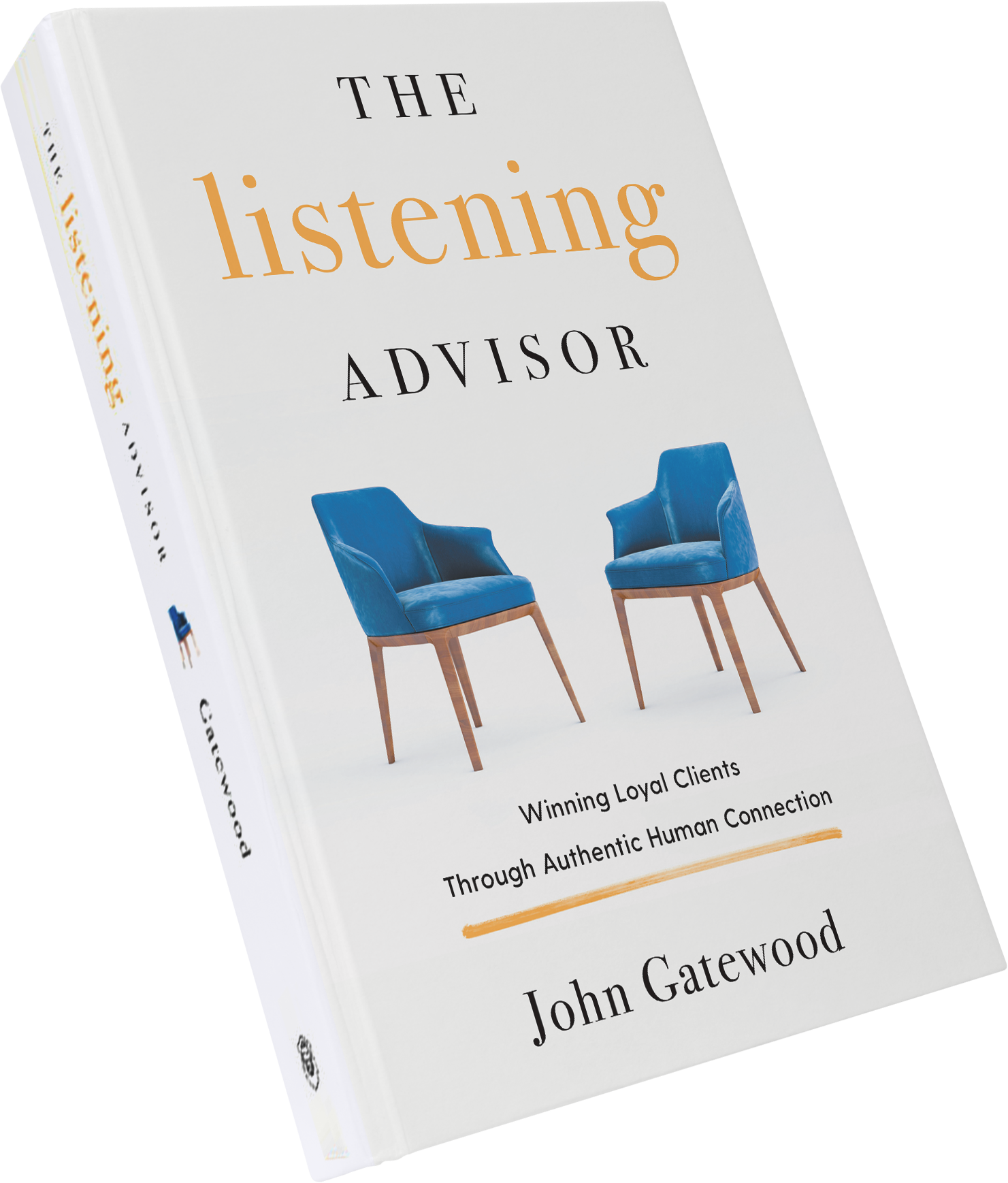
Pick up a copy of The Listening Advisor, or reach out to learn how The Listening Advisor™ can help you grow your AUM, deepen client relationships, and win clients who refer, advocate, and never leave.
John Gatewood is a CERTIFIED FINANCIAL PLANNER™ professional with forty-five years in financial services and the author of The Listening Advisor: Winning Loyal Clients Through Authentic Human Connection.