
A study of nearly 10,000 advisor meetings exposed something most of the profession has never seen. Here is what the data revealed, and the simple exercise that will tell you exactly where you stand.
Most financial advisors believe they’re good listeners. I did, too. For most of my forty-five years in this profession, I would have told you confidently that I let my clients do the talking, that I asked good questions and waited for the answers, and that I was the one in the room who understood that listening was the work.
Then I started looking at the data.
Researchers analyzing nearly 10,000 recorded advisor meetings found that 84 percent of advisors talked more than their clients. Eighty-four out of every hundred meetings. Every category. Every age group. Every level of experience.
The eye-opening finding came next. When those same advisors were asked beforehand who they thought did most of the talking in their meetings, 87 percent said it was their clients. Not the advisor. The client. They were sure of it.
Eighty-four percent of advisors talk more than their clients. Eighty-seven percent believe the opposite.
That’s not a small gap. That’s a profession-wide blind spot.
Why This Number Matters More Than Any Other in Our Industry
I’ve spent the last few years thinking about why this matters so much, and the answer keeps coming back to one thing. Clients don’t stay with advisors who have better information. They stay with advisors who make them feel genuinely understood. You can’t make a client feel understood while you’re doing 84 percent of the talking.
It doesn’t matter how good your planning is, how sophisticated your portfolio analytics are, or what your designations say. If the client walked out of the meeting feeling that you talked at them instead of with them, you’ve lost something that no return number will recover.
This is the quiet reason advisors lose clients despite strong performance, the quiet reason referrals never materialize from a client you thought was satisfied, and the quiet reason a less credentialed advisor down the street is somehow building twice the practice on half the technical depth. It’s not always this, but it’s this far more often than the profession likes to admit.
Why the Gap Is So Hard to See from the Inside
The data isn’t new, but advisors rarely see it. We don’t see ourselves the way our clients see us. We feel like we’re listening because we’re paying attention, we’re tracking, we’re nodding, and we’re forming our next question while the client is still speaking. Inside our heads, that feels like engagement. From the other side of the table, it doesn’t look the same.
I learned this lesson early in my career, though it took me years to fully understand it. My manager Pat decided to videotape me completing what we called a fact finder, which today we’d call a discovery meeting. Pat played the client, and I was nervous as could be. When we finished, my armpits were soaked and my face was flushed. We started to watch the video, and the first thing I noticed was that the back of my head was so flat. I’d always thought it was rounder.
Then I noticed the big thing. My eyebrows kept going up and down as I spoke, trying to emphasize points or ask questions. Up and down, up and down. I put my fingers on my eyebrows trying to hold them down. It was painful to watch.
That was the beginning of many videos and many joint calls. It taught me something I’ve carried for forty-five years.
You do not know what you do not know until you see it.
Why This Gap Is About to Cost Advisors More Than It Used To
For most of the history of this profession, you could be a so-so listener and still build a fine practice. Clients tolerated a lot, in part because they had nowhere better to go. The advisor was the one with the information, the advisor explained, and the client absorbed.
That world is closing fast. AI now does the explaining better than most advisors ever did. Faster, more clearly, and without ego. A client can ask a chatbot any financial question and get a competent, calm, well-structured answer in seconds. The thing that used to differentiate an advisor, which was being the one who knew, is becoming the thing that no longer differentiates anyone.
What’s left, the thing AI cannot do, is sit across from another human being and make them feel completely understood. Listen in a way that invites the truth. Pay enough attention to notice the word the husband emphasized, or the way the wife glanced at her hands when retirement came up. Wait long enough in a silence for the real answer to arrive instead of the rehearsed one. That work is the future of this profession, and you can’t do it while you’re doing 84 percent of the talking.
The One Exercise That Will Tell You Where You Stand
Here’s the part of this post where most advisors will be tempted to nod along, agree with the data, and change nothing. Don’t do that. Do this instead.
It’s called the Talk Time Check, and it takes one client meeting and twenty minutes of your time the next day.
Step one. Pick your next client meeting. With the client’s permission, record it. Most planning software, video platforms, and modern note-taking tools record meetings automatically now. If they don’t, use a phone.
Step two. The next morning, before you do anything else, listen to it back. Not all of it. Just the first thirty minutes.
Step three. Keep a simple tally on a piece of paper with two columns, Me and Client. Every time someone speaks, put a tick in the right column. Don’t count words. Don’t measure time. Just count the turns.
Step four. At the end of thirty minutes, look at the columns and be honest with yourself. Which side has more ticks?
That’s your number. Not a study. Not an average. Your number.
I’ve run this exercise with experienced advisors many times, and almost without exception, they’re surprised. Some are shocked. Almost all of them say some version of the same thing afterward. I had no idea I did that much of the talking.
That’s the moment the work begins. Until you see your own number, no amount of advice on this subject will stick. After you see it, you can’t unsee it. The next meeting, you notice. The meeting after that, you adjust. The meeting after that, something starts to shift in the way clients respond to you.
This is the first move in becoming a Listening Advisor™. Not a course. Not a certification. A simple count.
One Final Thing
If you do the Talk Time Check and find that you’re in the 84 percent, I want you to know two things.
The first is that you’re not unusual. You’re in the company of most of the advisors in this profession, including the ones whose names you respect. Almost none of us were taught to do this differently. The training in our industry has focused on what we say, almost never on what we hear.
The second is that this is fixable. Communication mastery is teachable, coachable, and measurable. I built a practice over forty-five years using exactly the discipline this exercise points toward, and so have many of the best advisors I’ve ever met. It’s a skill, not a personality trait. It can be learned, and it can be learned at any stage of a career.
The client meeting is not the dress rehearsal. The performance happens every time you walk through that door, and what you do before the meeting and what you notice afterward is what separates advisors who get better from advisors who get comfortable.
Do the Talk Time Check this week. Find out where you actually stand. That’s the beginning of the work.
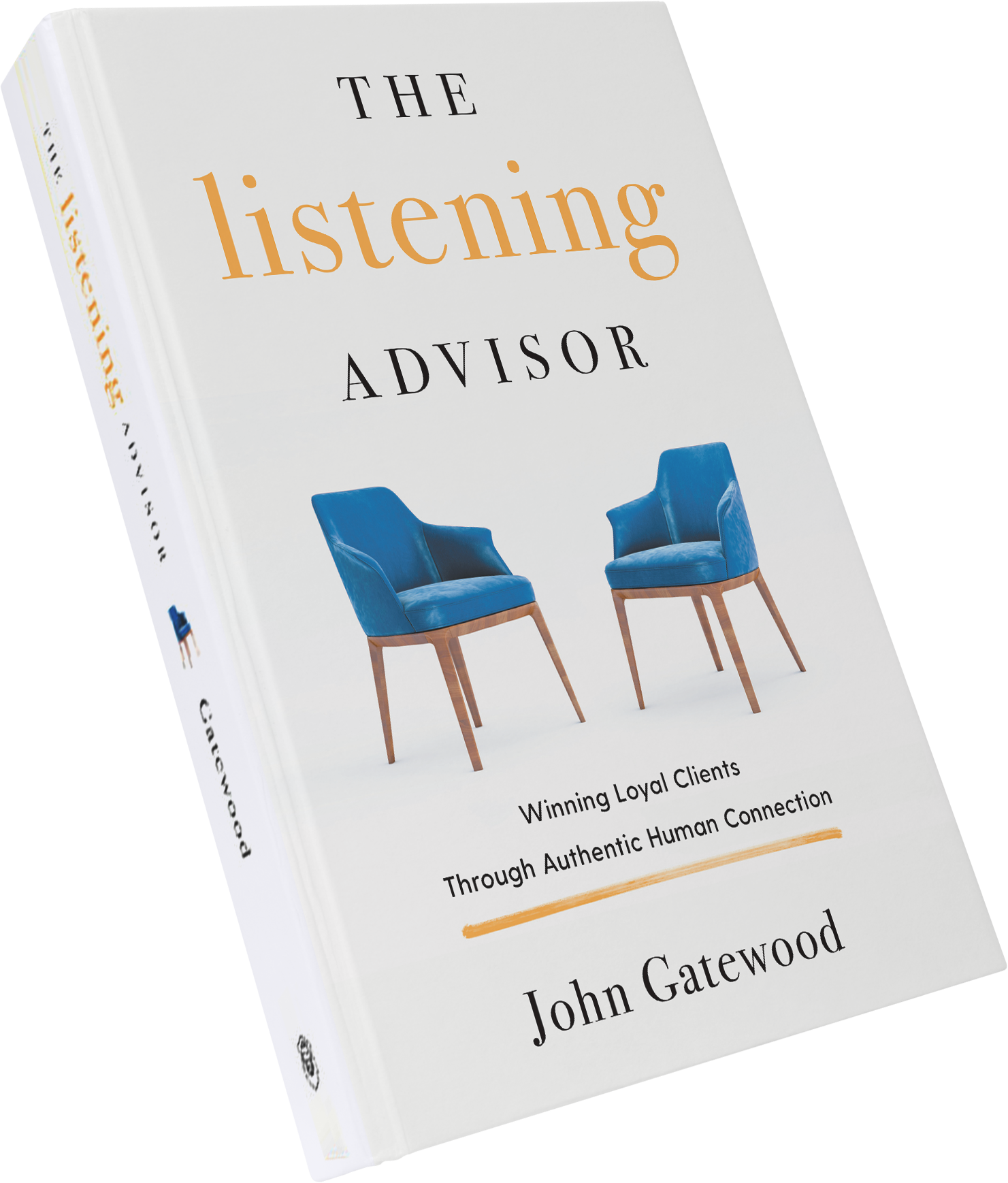
If you want to go deeper, The Listening Advisor™ is the book this exercise is built from, the system I used for forty-five years and the one I’m now teaching to advisors across the country. You can also take the free Self-Assessment at thelisteningadvisor.com to see which of the four advisor profiles you’re operating in today.