
So many advisors I talk to have a version of the same question right now. What’s AI going to do to my career?
Some are afraid. Some are excited. Most are somewhere in the middle, using a tool or two, hearing about firms that have gone all in, watching the younger advisors in the office build workflows the older partners don’t understand. The conversation has moved fast, and it isn’t slowing down.
After forty-five years in this profession, I’ve watched a lot of disruption come and go. Index funds were supposed to end us. Robo-advisors were supposed to end us. Fee compression was supposed to end us. None of those killed the profession. They reshaped it, and the advisors who paid attention came out stronger on the other side.
AI is different in one important way. The earlier disruptions changed how clients bought what we did. AI changes what we do.
That’s why this one matters. And that’s why the question every advisor should be asking right now isn’t Will AI replace me? It’s something better. What does the advisor who wins the next decade actually look like?
The answer is fluent in both. Fluent in AI. Fluent in humans. Neither alone is enough anymore.
Where AI Genuinely Helps an Advisor
I’m not anti-AI. The advisors who pretend AI isn’t here, or who refuse to learn the tools, are going to lose. The technology is too good, the speed is too high, and the clients of the next decade will expect us to be using it.
Here is where AI is doing real work for advisors today, the kind of work I’d want every advisor on my team to be using it for.
Meeting notes and transcripts. The tools that record and summarize a client meeting are already better than most advisors at capturing every detail. They free your hands and your eyes during the meeting itself, which is where you need to be most present.
First-draft writing. Emails, follow-up notes, client summaries, and planning explanations. AI gives you a first pass in seconds that used to take half an hour. Used well, it gives you time back. Used badly, it sends polished, generic messages that sound like nobody.
Scenario modeling. What used to take hours of building in planning software now takes minutes. Three different retirement scenarios. Five tax strategies. A side-by-side of two estate structures. AI does it fast enough that you can show a client real options in the same meeting they’re asked.
Pre-meeting preparation. Feed AI the client’s history and the agenda, and ask it for the questions you should consider asking, the concerns that might be unspoken, and the emotional dynamics likely to be present. Some of what it gives you won’t be right. Some of it will be questions you wouldn’t have thought of, and the act of reviewing them sharpens your own thinking before you walk into the room.
Reviewing your own meetings. This one matters more than advisors realize. Ask AI to read a meeting transcript and tell you where you interrupted, what questions the client asked that you didn’t fully answer, what emotions the client expressed and how you responded. AI doesn’t worry about your feelings, doesn’t soften the truth to preserve the relationship, and doesn’t get distracted by your credentials. It tells you what it sees, and what it sees is often exactly what you needed to hear.
That last one is the one I’d put a star next to. For the first time in this profession, advisors can see themselves the way their clients see them. That’s been the missing piece of communication development forever, and AI just solved it.
Where AI Quietly Hurts an Advisor
Here’s the part of the AI conversation almost nobody is having. The same tools that help advisors are quietly making some of us worse, and most of us don’t see it happening.
It tempts you to outsource the human work. A client sends you an emotional message about a parent in hospice and a financial decision they’re avoiding. You’re busy. You paste it into an AI tool and send back what it produces. The reply is polished. It’s the wrong reply. That client didn’t need polished. They needed you. The instinct to use AI for the emotional moments is the instinct that can cost you the relationship.
It produces communication that sounds like nobody. AI-generated emails tend to be longer, not shorter, and more formal, not clearer. They’re polished but completely generic, sounding like they could have been written by anyone to anyone. The client can tell. Maybe not consciously, but something feels off, because the message lacks your voice, your understanding of this specific client, your relationship.
It atrophies the skills you don’t use. This is the quiet one. If AI is handling first drafts, scenario modeling, and meeting prep, you’re not building those muscles anymore. That’s fine for the routine work. It is not fine for the harder, in-person human work, because that work runs on the same underlying skills. Reading a face. Hearing what’s underneath a question. Sitting with a silence. The younger advisors entering this profession have grown up texting more than talking. The risk isn’t that they don’t know how to use AI. The risk is that they’ve never built the harder muscle on the other side of the equation, and AI gives them a way to keep avoiding it.
It makes “looking productive” cheap. AI has made it easy to produce a lot of polished output very fast. That can be confused, by advisors and by firm leaders, with doing the work that actually matters. Twenty emails sent in an hour is not the same as one phone call that mattered. A perfectly drafted summary isn’t the same as a follow-up that referenced something personal the client mentioned three months ago. The trap is that the volume looks like progress while the relationship is quietly thinning out.
I’ve used AI for several years now. I use it every day. It’s earned a real place in how I work. But I’ve also caught myself reaching for it in moments where I shouldn’t have, where the right move was to pick up the phone or write something shorter in my own voice. The discipline isn’t whether to use AI. The discipline is knowing where it ends.
The Real Standard. Digital Fluency Plus Human Mastery
Here’s the standard I’d hold every advisor to, including myself.
Be excellent with the tools. Learn them. Build workflows around them. Don’t be the advisor whose practice gets passed over because you couldn’t keep up.
And be excellent at the work the tools can’t do. Sit with a grieving widow and read her unspoken fears. Wait long enough in a silence for the real answer to arrive. Notice the word the husband emphasized, or the way the wife glanced at her hands when retirement came up. Communicate with so much clarity and conviction that the client confidently acts on the recommendation.
That combination is what irreplaceable looks like in this profession. Not technology versus humanity. Both, at a high level, in the same advisor.
The advisor who wins the next decade is the one who uses AI to give themselves more time, more capacity, and more accurate self-awareness, and then spends every minute of that time on the human work that no algorithm will ever do.
An Exercise That Tells You Where You Are
I call it the Two-List Audit. Twenty minutes with a piece of paper and an honest look at your own week.
Step one. Take a sheet of paper and divide it into two columns. On the left, write Work AI Now Does for Me. On the right, write Work Only I Can Do.
Step two. Fill in the left column. Be specific. Don’t write categories. Write the actual things AI has taken off your desk over the last six months. The more specific, the better.
Step three. Fill in the right column. The work that requires you, in person, with a real client, doing things no tool can do. Again, be specific. Not principles. Actual moments from the last few months.
Step four. Now the question that matters. Look at both columns and ask yourself one thing. Has anything started crossing the line in the wrong direction? Has AI quietly taken over work that belonged in the right column? Has my version of being efficient started to mean being less human?
Step five. Pick one item, just one, that has crept across the line. Decide what to take back this week.
That is what digital fluency plus human mastery looks like in practice. Not a slogan. A choice you make in the middle of a real client week, one item at a time.
One Final Thing
The advisors who panic about AI will struggle. The advisors who go all in on AI and let it eat the human side of their work will also struggle, just more slowly and less visibly.
The advisors who win, the ones who are still in this profession ten years from now with practices clients refer and never leave, are the ones who learn to be fluent in both. Digital fluency in the tools. Human mastery in the work that matters. That has always been what great advisors did. AI simply made it urgent.
Becoming a Listening Advisor™ has never been about resisting technology. It is about knowing exactly where you, and only you, are the irreplaceable part of the relationship, and protecting that with everything you’ve got.
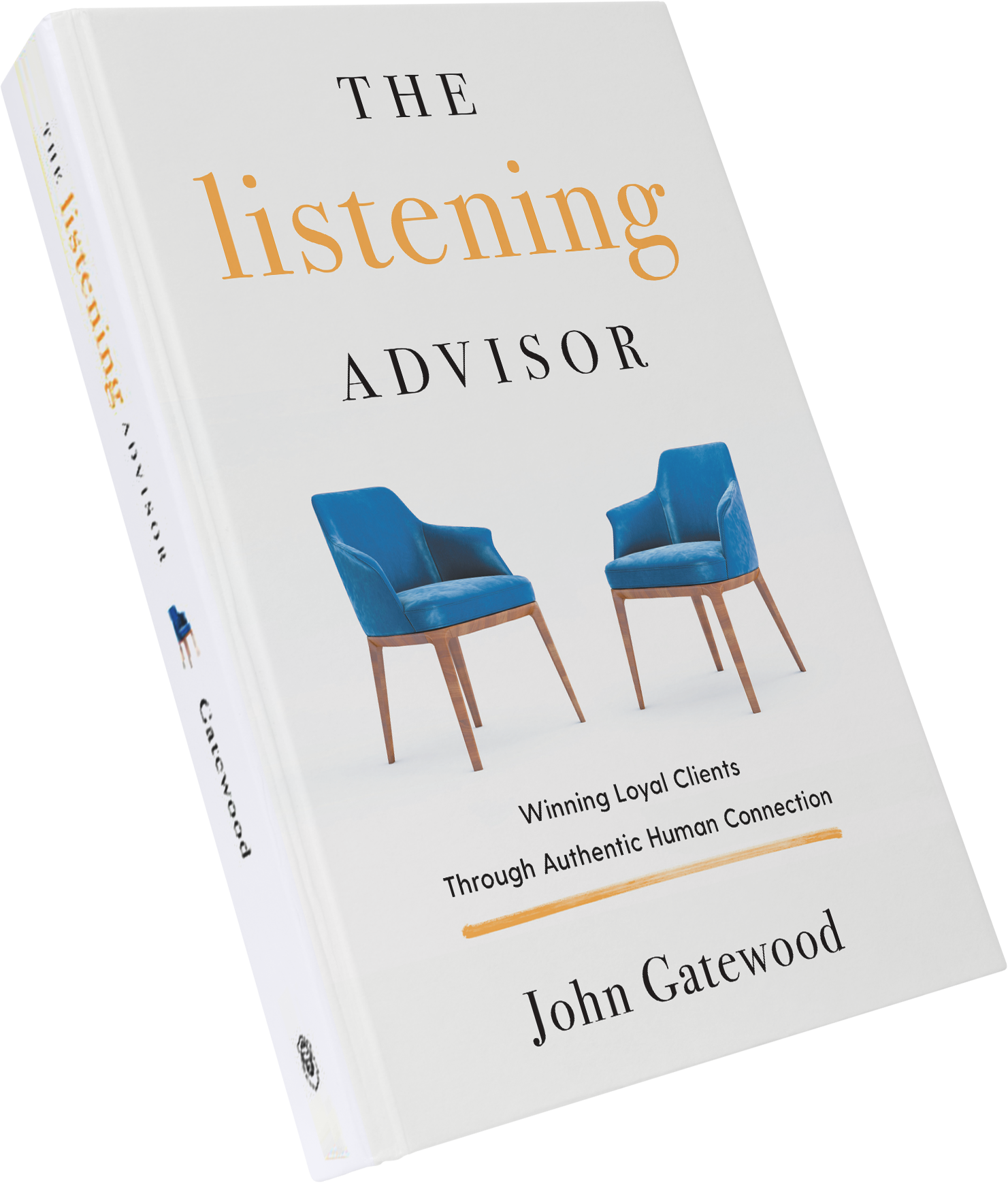
If this is the question you’re wrestling with, The Listening Advisor™ is the book built around it. The free Self-Assessment at thelisteningadvisor.com will show you which of the four advisor profiles you’re operating in today, and where the highest-leverage growth in your practice lives.