
Cerulli Associates publishes a number that our entire profession has somehow learned to live with. Seventy-two percent of new advisors fail within five years.
Seventy-two out of every hundred people firms recruit, train, license, supervise, and pay are gone before they ever build a real practice. Some firms do better. Many do worse. A handful retain only one or two out of every ten new advisors they hire.
The standard explanation is that those advisors couldn’t make it in a hard business. The truth I have watched play out for forty-five years is different. The advisors who fail in year two or year four rarely fail because they couldn’t explain a portfolio or build a financial plan. They fail because they could not build a relationship. And the one skill that would have changed that outcome, the ability to listen, to be present, to make a client feel genuinely understood, is barely in the curriculum.
That is the training crisis. It’s hard to fix, so no one has. I’m going to explain why it has been hard, what is now possible, and what real communication training can actually deliver for a firm willing to build it.
What Advisor Training Looks Like Today
The investment firms make in advisor development is significant. The training departments are serious operations with smart people, real budgets, and sophisticated content. The investment is real. The focus is where the issue lies.
Look at what that investment is spent on, and the picture is consistent.
Products. New advisors learn the firm’s product shelf in detail. Features, benefits, suitability requirements.
Planning software. How to build a plan. How to model retirement. How to print a deliverable a client will accept.
Compliance. What you can say, what you can’t, what you must disclose, how to document everything.
Markets and economics. How to talk about the news. How to position the firm’s investment philosophy.
Sales process and prospecting. How to find clients, how to qualify them, how to ask for the close.
Programs also typically include a discovery questionnaire, the document the advisor walks through with a prospect or new client to gather the information needed to build a plan. The questionnaire itself isn’t the problem. The problem is what advisors are taught to do with it. They are trained to focus on the data facts. Income, assets, account balances, time horizons, beneficiary names. These are the inputs needed to produce a financial plan.
What they are rarely trained to gather, and rarely trained to even notice, are the feeling facts. The fears beneath the goals. The family history sitting behind the legacy question. The fight between spouses about retirement that they haven’t told anyone about yet. Decisions are driven by feeling facts. Plans are built from data facts. Training teaches the second half and skips the first.
I’m not knocking any of this. All of it is necessary, but it’s not sufficient.
Now look at what’s missing. Communication. Listening. Presence. How to sit with a fearful client. How to read a face. What to do with a silence. How to ask the question that gets to the real answer instead of the rehearsed one. How to speak so clearly and compellingly that the client confidently acts on the recommendation.
In typical training programs, that gets a half-day. A role-play. A chapter in an onboarding manual. Then the new advisor is sent into the field to figure it out on their own.
The industry has built the most technically sophisticated training infrastructure in the history of this profession and has almost completely ignored the one skill that determines whether the advisor builds a career at all.
Why Real Communication Training Has Always Been Hard to Deliver
This is the part of the conversation that gets skipped, and it’s the part that explains why so few firms have solved this problem.
Teaching human communication skills is fundamentally different from teaching planning software or compliance. An advisor can sit through a training program on listening, take notes, score well on a quiz, and walk out unchanged. The principles are easy to absorb. The behaviors are hard to install.
The real learning happens in the client meeting, not just in the classroom. For a manager or trainer to actually help, the development has to look something like this. The manager sits in on a client meeting, observes what the advisor said and didn’t say, watches how the advisor handled a pause, asked a follow-up question, missed an opening, or jumped in too soon. Then they spend ten or fifteen minutes afterward debriefing with the advisor on what was done well and what could have been done better.
Then they do it again. And again. And again.
A product course can be delivered to a hundred advisors at once. A compliance webinar runs once a quarter. Communication coaching, in any meaningful way, has to happen one meeting at a time, with someone who can see what the advisor cannot, and call it the way it actually happened.
Few firms make that investment at scale. Not because they didn’t believe it mattered, but because the math didn’t work. The time required to do it well, multiplied by the number of advisors who needed it, made it prohibitive to deliver firm-wide.
That is why the training has stayed at the half-day-and-a-role-play level for decades. The will was rarely the problem. The labor cost was.
What AI Just Changed
The math is changing fast, and many firms haven’t fully realized it yet.
AI now records meetings, produces full transcripts, and analyzes what happened in the conversation. A tool can read a transcript and tell an advisor where they interrupted, what questions the client asked that weren’t fully answered, what emotions the client expressed and how the advisor responded. That kind of analysis used to require a senior coach sitting in the room. Now it can be produced in minutes by software the advisor already has on their laptop.
For the first time in this profession, an advisor can see their meetings the way a coach would see them, without needing a coach to physically be there. That changes the economics of communication coaching in a way many firm leaders have not yet thought through.
A manager or trainer no longer has to be in every meeting to be useful. They can review transcripts and AI-generated summaries, spot patterns across a dozen meetings in the time it used to take to sit through one, and focus their coaching time on the moments that need it. The advisor can do the same review on their own and arrive at the debrief already aware of what happened. The labor cost has been cut by a factor that finally makes the work possible at firm scale.
There is still no substitute for seeing yourself on camera. AI can tell an advisor they interrupted. It cannot quite produce the moment an advisor watches themselves do it on screen. Seeing it for yourself is still the most powerful teacher in this work. AI now does the analysis. The advisor still has to do the looking.
The tools are finally in place. The cost has come down. The barrier to doing this work right has fallen further in the last two years than in the previous twenty.
What Real Communication Training Can Build for a Firm
This is where firm leaders should be paying close attention, because the upside of getting this right is significant and concrete.
A firm that builds real communication training over the next twenty-four months will look fundamentally different from its competitors.
Lower turnover. The seventy-two percent failure rate is not a permanent feature of this profession. It is a function of training that hasn’t addressed the actual reason advisors fail. Firms that build communication mastery into early-career development will keep advisors who would have left, and the retention math is significant. The cost of replacing a failed advisor in their second year is far higher than the cost of training them well in their first.
Higher client retention. Clients don’t leave advisors who make them feel genuinely understood. They leave advisors who did the job and missed the relationship. Communication mastery is the difference between those two outcomes. Firms whose advisors are trained on it see retention numbers competitors can’t match.
Referrals that compound. The advisors who get this right generate referrals without asking, because their clients have an experience worth telling someone else about. The growth math on a referral-driven practice is exponentially better than on a prospecting-driven practice. A firm full of advisors who can do this builds itself.
A reputation in the marketplace. Top advisors want to work at firms that develop them. The firm known in the industry as the one that genuinely builds communication mastery, not the one that says it values it, becomes the firm top talent wants to join.
A culture that survives AI. As technology absorbs more of the technical work, firms whose identity is built on what AI can do are going to look increasingly commoditized. Firms whose identity is built on what AI cannot do will look increasingly irreplaceable.
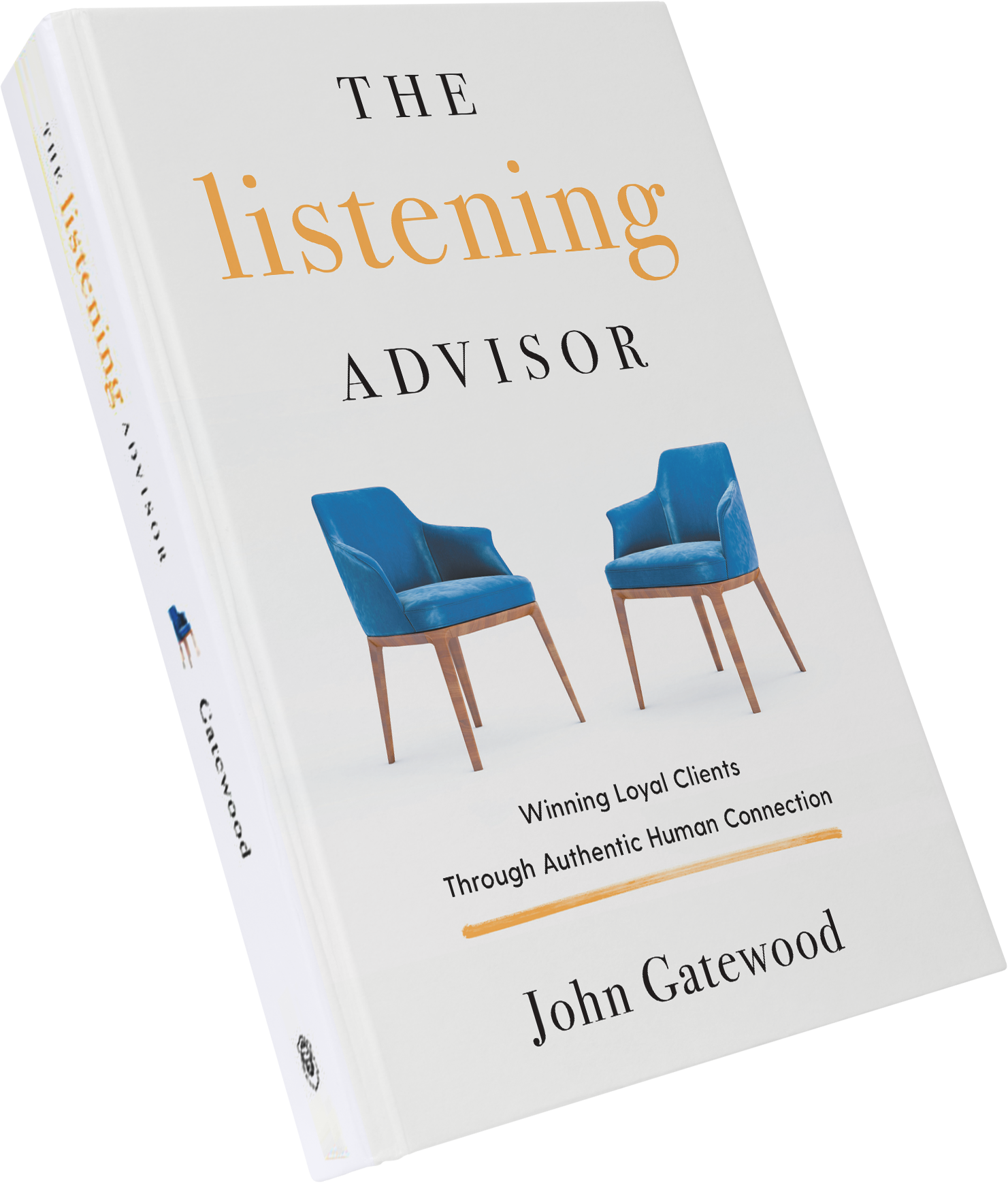
These are not theoretical benefits. They are the outcomes I’ve watched produced consistently, over forty-five years, by advisors who built their practices on exactly this skill set. They are also the outcomes The Listening Advisor™ framework is designed to produce at firm scale.
What Training That Sticks Looks Like
Three characteristics show up in every program I’ve ever seen produce real change.
It uses real footage of real meetings. Recordings, transcripts, AI-generated analysis of the advisor’s own conversations. You cannot coach a skill you can’t see. Technology has finally solved that problem.
It includes someone who will be straight with you. A coach, a manager, a colleague, an outside resource. Self-coaching has limits. The advisor needs someone outside themselves holding them accountable, especially in the first ninety days when the new habits are forming.
It is led by people who can do the work, not just teach it. Communication training is more credible and more effective when it is delivered by people who have actually built practices doing what they are teaching. Advisors can tell the difference within ten minutes.
The Listening Advisor™ framework is built around those characteristics. It also brings something the industry has been missing, a framework built by someone who actually did this work, successfully, over a forty-five-year career. Not a consultant studying it from the outside. An advisor who built a Barron’s Top 1,200 practice using exactly the principles in the framework, kept clients through every market cycle, and generated referrals for four decades without ever asking. The communication skills The Listening Advisor™ teaches are the same skills I used to build the practice. They worked then. They work now. And they are the skills advisors and firms should be following, because the proof has already been built.
Three Questions for Firm Leaders
If you lead a firm, or you’re responsible for advisor development inside one, take a piece of paper and answer three questions about your current training.
Where does my firm’s advisor training budget actually go? Not the values statement. The hours, the dollars, and the calendar.
What does my firm measure to know whether that training worked? If the answer is we don’t really measure it, you have identified why the training doesn’t stick.
If I had to point to one advisor on my team whose meetings have measurably improved in the last twelve months, could I? If the answer is no, the development system in your firm is producing activity, not improvement.
Three questions. Twenty minutes. The answers are where the next year’s most important work lives.
One Final Thing
Communication mastery, where one learns to listen so well clients feel heard and understood, and to speak so clearly and compellingly that clients confidently act on our recommendations. Communication mastery is the tool. Authentic connection is the outcome. Authentic connection is what wins clients who refer, advocate, and never leave. And it is the one thing AI cannot replace.
I sold my practice in 2021 after forty-five years in this profession. I didn’t have to do this work. I’m doing it because communication mastery should be the standard in this profession, and the way advisors are trained today is not producing it.
This is the most fixable problem the industry has. The principles are knowable. The skills are teachable. The tools to deliver real coaching at firm scale are finally in place. The framework built on a forty-five-year career of doing exactly this work is now available.
The firms that take this seriously are the firms whose advisors will still be in this profession ten years from now, with practices clients refer to their friends and never leave. That is the opportunity. The training crisis is hard to fix. The reward for firms willing to fix it has never been bigger.
The Listening Advisor™ is the book and the framework built for firms that want to take communication training as seriously as they take technical training. If you are a firm leader, training director, or advisor development lead, reach out at thelisteningadvisor.com. The Listening Advisor™ system is being built precisely for this moment in the profession.