
I have spent forty-five years in financial services. I built a practice, sold it in 2021, and I have watched more technology cycles roll through this industry than most advisors entering it today will see in their careers. None of them worried me the way this one does. Not because artificial intelligence is dangerous on its own. Because of what it quietly tempts us to stop doing.
The skill you stop using is the skill you lose. For an advisor, the skills most at risk are the exact ones that make you irreplaceable.
The Muscle You Forget You Have
Think about the last time you used a navigation app to drive somewhere you used to know by heart. You arrived. You also arrived having learned nothing about the route. You stopped building the mental map because the map built itself. Multiply that across every decision, every client insight, every original idea, and you start to see the real cost of leaning on AI without discipline.
Creativity and critical thinking work like muscles. They strengthen with use and atrophy with neglect. When an advisor reaches for AI to generate the client email, frame the planning conversation, and produce the insight, the output looks polished. The advisor behind it is getting weaker with every shortcut. The polish hides the atrophy until the moment you need original thought and find the muscle has gone soft.
Ask yourself honestly: when AI writes your first draft, are you editing it, or are you simply approving it? Those are not the same act. One keeps your judgment in the loop. The other slowly removes it.
Why This Hits Advisors Harder Than Anyone
Most professions can absorb some loss of original thinking. Yours cannot. The entire competitive advantage of a financial advisor in an AI-driven world is communication, the ability to listen to a human being, perceive what they are really saying, and connect it to an insight no algorithm would reach. That advantage is not built on product knowledge or market calls. Those are commodities now. It is built on critical and creative thinking applied to a single human across the table from you.
Consider what real listening actually requires. A client tells you they want to retire at sixty-two. AI can log that goal. It cannot hear the slight hesitation in the way they said it, connect it to the comment they made twenty minutes earlier about their father’s early death, and gently ask the question that surfaces the real fear underneath the number. That synthesis is a creative act. It happens in the moment, in your own mind, or it does not happen at all.
AI can transcribe what a client says. It cannot perceive what a client means. That gap is your entire value.
I learned this the hard way over decades of client meetings, long before anyone used the word algorithm in this business. The breakthroughs never came from the data. They came from the question I asked because I was thinking creatively about the human in front of me, not reciting a script. An advisor who outsources that thinking does not just sound generic. They forfeit the one thing that earns a client who will refer, advocate, and never leave.
So Do We Reject the Tool? No.
Here is where warnings about AI go wrong. They tell you to fear it or avoid it. That is bad advice and you would be right to ignore it. The advisors who refuse AI entirely will be buried by the ones who use it well. The answer is not rejection. It is the right relationship with the tool.
Picture a master carpenter with a nail gun. The tool makes the work faster and the result cleaner. It does not decide where the house goes, what the client needs, or whether the design is any good. The carpenter still does the thinking. The tool does the hauling. Treat AI as the apprentice, never the author, and you get the speed without the atrophy.
Use AI for the mechanical and the first pass: research, summarizing a long document, organizing your notes, drafting a routine message you will then make your own. Reserve for yourself the two things that cannot be delegated without losing your edge: forming your own judgment, and the human connection that lives in a real conversation. The advisor stays the author. AI is the apprentice.
The Test That Keeps You Sharp
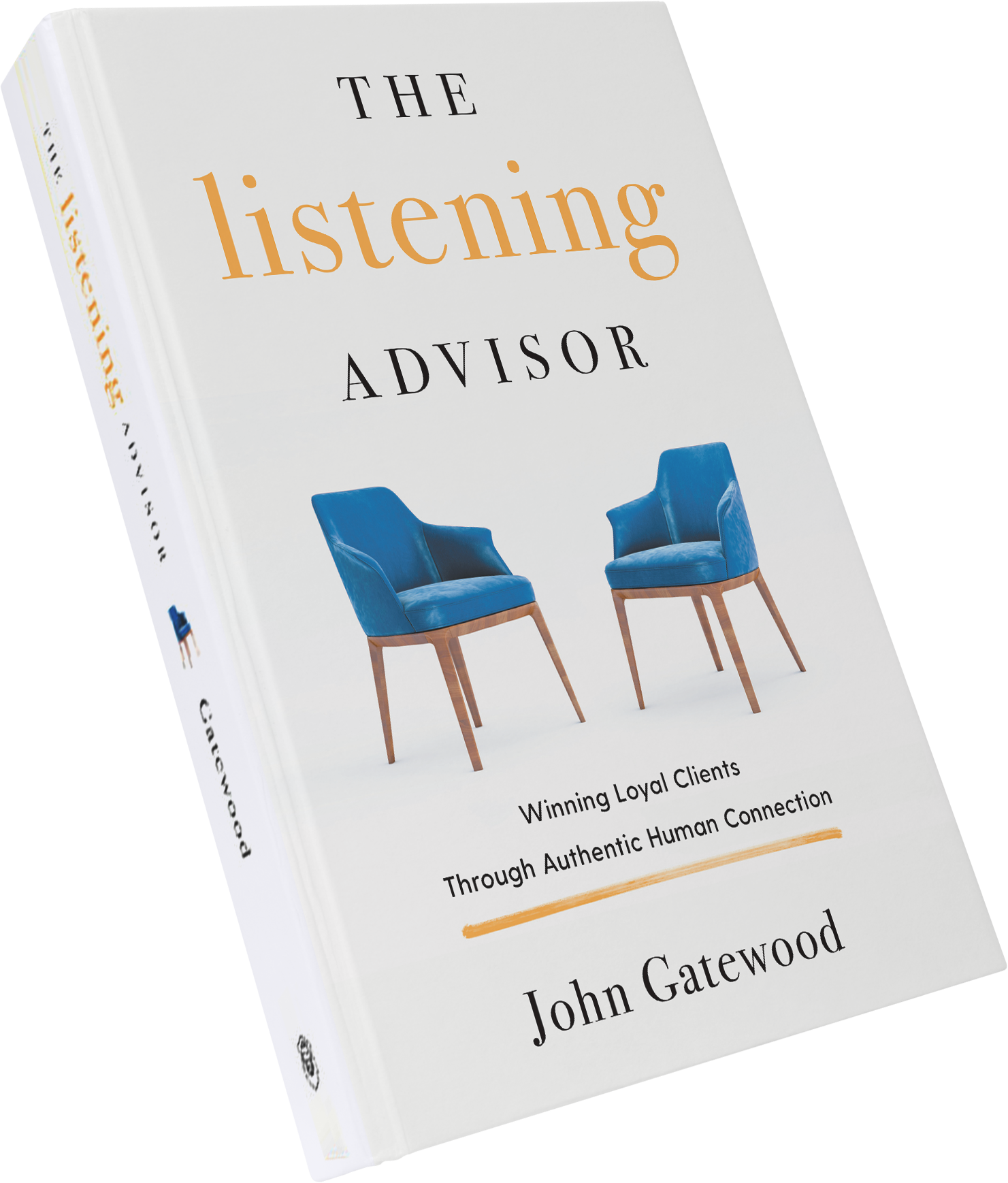
There is a tool in The Listening Advisor that happens to be the perfect antidote to thinking atrophy. After a client finishes explaining a goal, a worry, or a decision, you reflect it back to them in two passes. First, feed it back in their own words, so they hear their own words land. Then, reflect it back in your own words, capturing the meaning and the emotion underneath what they told you. The whole point is to check whether you heard them correctly, and to let them feel it. Because clients do not stay for the accuracy of your plan. They stay for how you make them feel, and what they want most is to feel heard and understood.
Why does this protect you from the AI trap? Because you cannot fake it and you cannot outsource it. Reflecting a client back demands original synthesis, performed live, in your own voice, drawing on your own perception of this specific human. No model can do it for you because no model was in the room hearing what you heard. Every time you do it, you exercise exactly the muscle AI tempts you to let go soft. Do it in every meeting and your critical and creative thinking stays in peak condition, whether or not AI drafted your follow-up email afterward.
Your Action Step This Week
Pick one task you have started handing to AI completely, the client email, the meeting prep, the planning summary. Before you let AI touch it, spend five minutes generating your own thinking first: your own questions, your own angle, your own words. Then bring in AI to sharpen, research, or tighten what you already created. You stay the author. The tool stays the apprentice. Notice how different the result sounds when the thinking started with you.

The Bottom Line
AI will make average advisors faster at being average. It will make great advisors even harder to compete with, but only if they keep doing their own thinking. The advisors who treat AI as a crutch will all start to sound alike, because they are drawing from the same well of machine-generated sameness. The advisors who treat it as leverage will sound like themselves, think like themselves, and connect like no machine can.
In an industry racing to automate everything, your willingness to keep thinking is not nostalgia. It is your moat. Guard it.
Ready to become the advisor no machine can replace?
Pick up a copy of The Listening Advisor, or reach out to learn how The Listening Advisor™ can help you grow your AUM, deepen client relationships, and win clients who refer, advocate, and never leave.
John Gatewood is a CERTIFIED FINANCIAL PLANNER™ professional with forty-five years in financial services and the author of The Listening Advisor: Winning Loyal Clients Through Authentic Human Connection.