
Every advisor reading this has had this phone call. The market is dropping, the news cycle is apocalyptic, and a client calls with a voice tight from stress, saying some version of I want out. Sell everything. I can’t watch this anymore.
What you say in the next three minutes will shape everything that happens next. It will determine whether the client stays in the plan or sells at the bottom, whether they trust you more or less three months from now, and whether they tell other people about you or quietly move their money to someone else.
I have been on the other end of those calls hundreds of times across forty-five years, and the difference between the conversations that work and the ones that don’t is rarely the data or the historical returns. The difference is how the conversation opens.
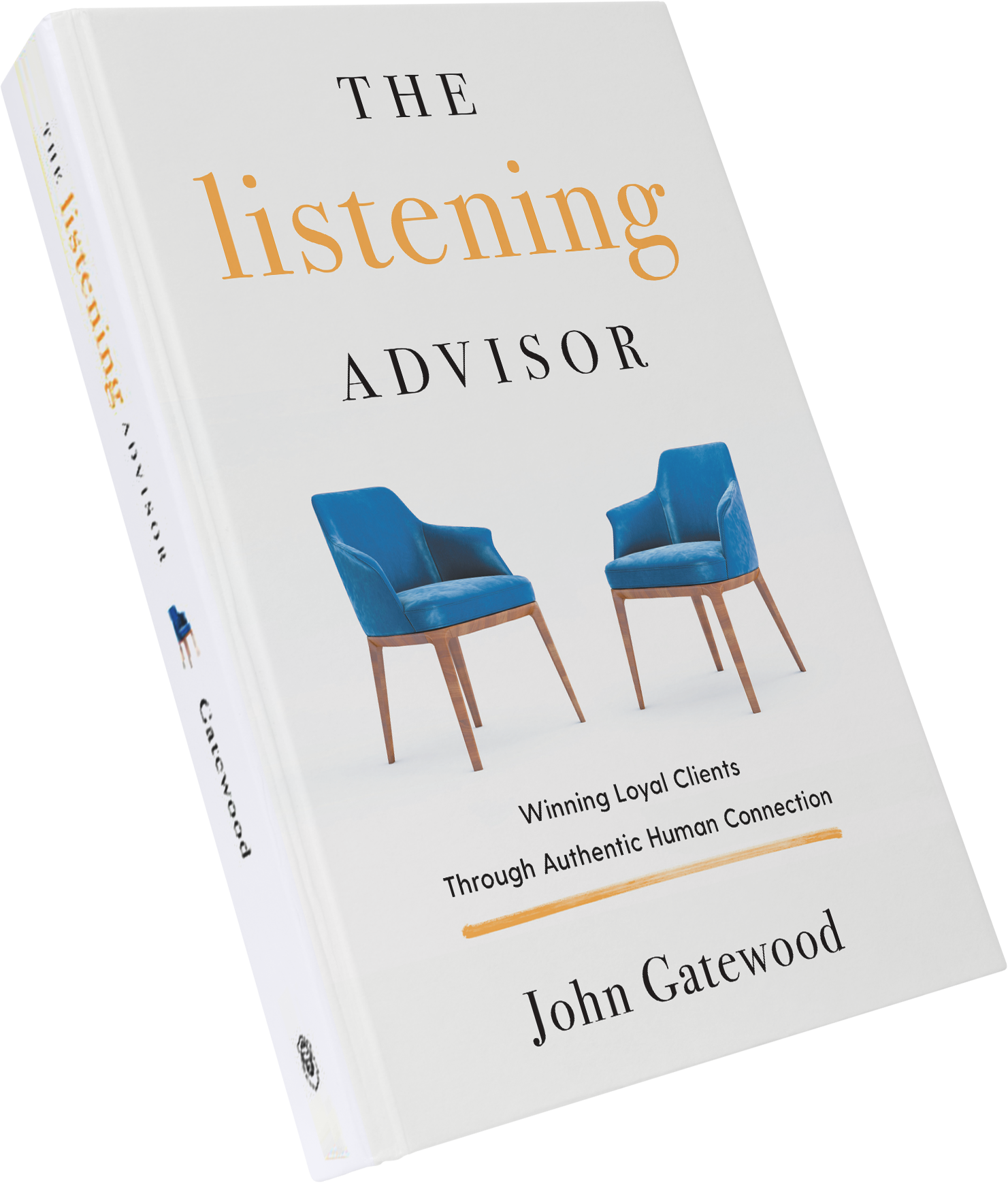
This is one of the most important applications of the The Listening Advisor™ framework, because the moments that matter most are also the moments where the wrong opening can do real damage. The instinct is to rush to the data. The client says I want out, and the advisor responds with historical recovery rates, the cost of missing the rebound, and the reminder that the plan accounts for this. All of that information is correct, and none of it is what the client needs in the first three minutes. The client is not asking for data, they are afraid, and the fear has to be received, named, and acknowledged before any information will be heard. The moment a client feels misunderstood, the rest of the conversation is uphill.
The Listening Advisor Pause
The first move is the one the book calls the Listening Advisor Pause. It is not a counted three seconds, but the deliberate practice of receiving what the client is saying before you respond, letting their fear sit in the room without rushing to manage it. The client has just told you they are afraid, and the pause says I heard that, I am here, and I am not in a hurry to fix you. The Pause is one of the core disciplines in the book, and it sets the conditions for everything that follows.
Feel, Felt, Found
Feel, Felt, Found is not original to me. It is a classic sales structure that has been taught across financial services and other industries for generations. What I’ll show you is how I have used it for forty-five years in the moments that matter most.
The full version is in the book, but here is the part that matters most for the opening of the call.
Start with Feel. Invite the client to say more about what they are feeling.
Wow. Dave, I hear how you feel. Tell me more about that. When you said you want out, what did you mean? Tell me more about what’s driving that.
The goal of this stage is to get the emotion out, named, and acknowledged. You are not solving anything yet, you are inviting the client to put what they’re feeling fully into words. Once a feeling is named out loud and received without judgment, it begins to lose its grip on the client, and the conversation can move forward. Stay in this stage longer than feels natural because the urge to race through it and deliver the information you have prepared is exactly what you need to resist.
From there, the conversation moves through Felt, where you normalize the emotion by reminding the client that others have felt this way, and then into Found, where you finally deliver the information you wanted to give in the first place. Those two stages are where most of the work of the book lives, and they are also where advisors tend to put almost all of their energy in moments like this, without realizing that Felt and Found only work if the Feel stage was done properly first.
The Messenger Is the Message
Here is the principle from the book that ties all of this together. The information you deliver in the Found stage will only work if the client believes you mean it. If the advisor delivers the same words from a script, the client hears them and dismisses them. If the advisor delivers those words with real conviction because they’ve lived them, watched them across multiple market cycles, and believes them down to the foundation, then the client exhales.
Same words. Two completely different effects.
The book calls this “the messenger is the message”. In ordinary moments, the words carry most of the weight, but in moments of high stress where the client has no internal steadiness to draw on, the messenger carries the weight. The client is not just listening to what you say, they are reading your certainty and deciding in real time whether the steadiness in your voice is something they can borrow. That steadiness cannot be manufactured. It is the product of years of work on yourself and on the relationship with the client.
A Story from 2020
In March 2020, the market dropped 34 percent in 23 days. I had a couple I’ll call Michael and Sarah, both clients of mine, both in their fifties, both well-prepared. Both called me in that week, terrified, asking the same questions, and I ran the same framework with each of them, including the pause, the invitation to say more, the acknowledgment, and the conviction.
Michael sold everything. The fear was too great. Sarah, hearing the same words, said I’m terrified, but I also know this is when I need to have confidence in the plan and not abandon it, and she stayed invested. One year later, Sarah’s portfolio had grown more than 50 percent from the March lows, and Michael’s account sat in cash.
I tell that story not because Michael did anything I could have prevented, but because the difference between the two of them started long before March of 2020. It started in the years of conversations where Sarah’s connection to me had become strong enough that, at her most afraid, she could borrow my steadiness when she could not find her own. The messenger was the message for Sarah. With Michael, the same conviction and the same explanation didn’t reach deeply enough for him to do the same, even though he heard every word.
That is what the listening discipline produces, not control over every client decision, but influence in the moments where influence matters most.
The Exercise. Try This in Your Next Three Calls
For the next thirty days, in every client conversation where the client expresses fear, frustration, or panic, do three things.
One. Use the Listening Advisor Pause. Receive what they said before you respond, and resist the urge to fill the space with reassurance.
Two. Start with Feel. Ask them to say more about what they’re feeling and let them keep talking longer than you would normally.
Three. Pick one line you want to be able to deliver with full conviction in a moment like this, and start refining it. Practice it until it comes out of your mouth naturally, with the weight of belief behind it. The book walks through how to develop the lines that move a client’s mind in the Found stage, and the work of choosing your own and practicing it starts now.
That is the entire discipline. The client conversations that follow will be different. You will notice clients dropping their guard faster, yourself thinking more clearly, and over time the panic calls will stop escalating the way they used to.
One Final Thing
The market will drop again, and when it does, the phone will ring. What separates the advisors clients stay with from the advisors clients leave is the structure of those first three minutes, and the depth of connection that has been built in the ordinary moments long before the panic call.
You cannot manufacture any of that in the moment of the call. You build it across every ordinary meeting, every routine review, every small conversation where you acknowledged a feeling instead of rushing to advice. The work you are doing now, in the quiet moments, is the work that pays off when the market drops.
That is what The Listening Advisor™ is built to produce. Advisors’ clients call in their hardest moments, and clients who hear what their advisor says when it matters most.
Is this the conversation you want to be ready for?
If you want to be the advisor your clients call in their hardest moments and trust when it matters most, The Listening Advisor™ is the book built around exactly that. Take the free Self-Assessment at thelisteningadvisor.com to find out which of the four advisor profiles you’re operating in today and where the highest-leverage growth in your practice lives.